
Best Drones for Real Estate Photography 2026: Pro’s Complete Guide
 14 min read
2,759 words
14 min read
2,759 words
Introduction
If you are a real estate photographer or agent looking to add aerial imagery to your services in 2026, you need to know which drone delivers the best image quality while keeping you on the right side of FAA regulations. Selecting the best drones for real estate photography is not just about camera specs; it is about understanding the legal requirements, flight performance, and return on investment that a commercial drone operation demands. In this complete guide, you will learn which models excel for property shoots, exactly what FAA rules apply to your business, and how to price your new aerial service profitably. We will cut through the marketing hype and give you the practical, actionable information you need to make a smart purchase and fly legally from day one.
Do You Need a Part 107 License for Real Estate Drone Photography?
This is the single most important question for any real estate professional considering drone use. The answer is a definitive yes. Any flight that is in any way connected to a business purpose—whether you are the listing agent flying the drone yourself or hiring a photographer—requires a Remote Pilot Certificate under FAA Part 107. There is no exception for small drones, no exception for “just taking a few photos,” and no exception for flying over your own listing.
Flying without a Part 107 certificate for commercial real estate work exposes you to significant penalties from the FAA, including fines of up to $1,100 per violation. More importantly, it creates liability issues if an accident occurs. The process to get your certificate involves passing a knowledge test at an FAA-approved testing center, which costs around $175 and requires study of airspace rules, weather, and drone operations. Once you pass, you must renew your certificate every 24 months by completing a free online recurrent exam.
Best Drone for Real Estate Photography 2026: Top Picks Compared
The market in 2026 offers several excellent options, but three models stand out for real estate work. Each serves a different budget and performance need. Below is a direct comparison of the top contenders.
| Drone Model | Best For | Camera Sensor | Flight Time | Weight | Price (Approx.) |
|---|---|---|---|---|---|
| DJI Mavic 3 Pro | Best overall image quality | 4/3 CMOS Hasselblad | 43 minutes | 958g (2.1 lbs) | $2,199 |
| DJI Air 3 | Best value for professionals | 1/1.3-inch dual camera | 46 minutes | 720g (1.6 lbs) | $1,099 |
| DJI Mini 4 Pro | Portable entry-level commercial | 1/1.3-inch | 34 minutes | 249g (0.55 lbs) | $759 |
DJI Mavic 3 Pro: The Best Camera Drone for Real Estate
If image quality is your top priority, the Mavic 3 Pro is the best drone for real estate photography in 2026. Its 4/3-inch Hasselblad sensor captures significantly more light and dynamic range than smaller sensors, which matters when shooting properties with bright windows and dark interior shadows. The triple-camera system gives you a 24mm wide-angle for standard shots, a 70mm medium tele for detail shots of architectural features, and a 166mm telephoto for distant context. For real estate, the wide-angle lens is your primary tool, and its 20-megapixel resolution delivers images that print beautifully at large sizes for brochures or wall displays.
The gimbal stability on the Mavic 3 Pro is class-leading, producing buttery-smooth video even in moderate wind. This is critical for property exterior tours where any camera shake looks unprofessional. Flight time of 43 minutes means you can cover a large estate or multiple properties in a single battery cycle, reducing time on site. The omnidirectional obstacle avoidance system gives you confidence when flying through tight suburban streets with trees and power lines.
DJI Air 3: Best Value for Real Estate Drone Photography
The DJI Air 3 hits the sweet spot between price and professional capability for most real estate photographers. Its dual-camera system includes a wide-angle and a 3x medium tele lens, allowing you to capture both expansive property overviews and closer architectural details without digital zoom. The 1/1.3-inch sensor is smaller than the Mavic 3 Pro’s, but still produces excellent dynamic range for HDR real estate photos. In practice, the Air 3’s images require slightly more post-processing to match the Mavic 3 Pro’s shadow detail, but for most listing photos, the difference is negligible.
At 46 minutes of flight time, the Air 3 actually outlasts the Mavic 3 Pro, which is a real advantage when shooting multiple properties in a day. Its 45-degree forward and backward obstacle avoidance is sufficient for most suburban environments, though you need to be more careful with side movements. The Air 3 supports all the shooting modes you need for real estate: panorama, orbit, and hyperlapse. For under $1,100, this is the best camera drone real estate professionals can buy without stretching to the flagship model.
DJI Mini 4 Pro: Can You Use a Sub-250g Drone for Commercial Real Estate?
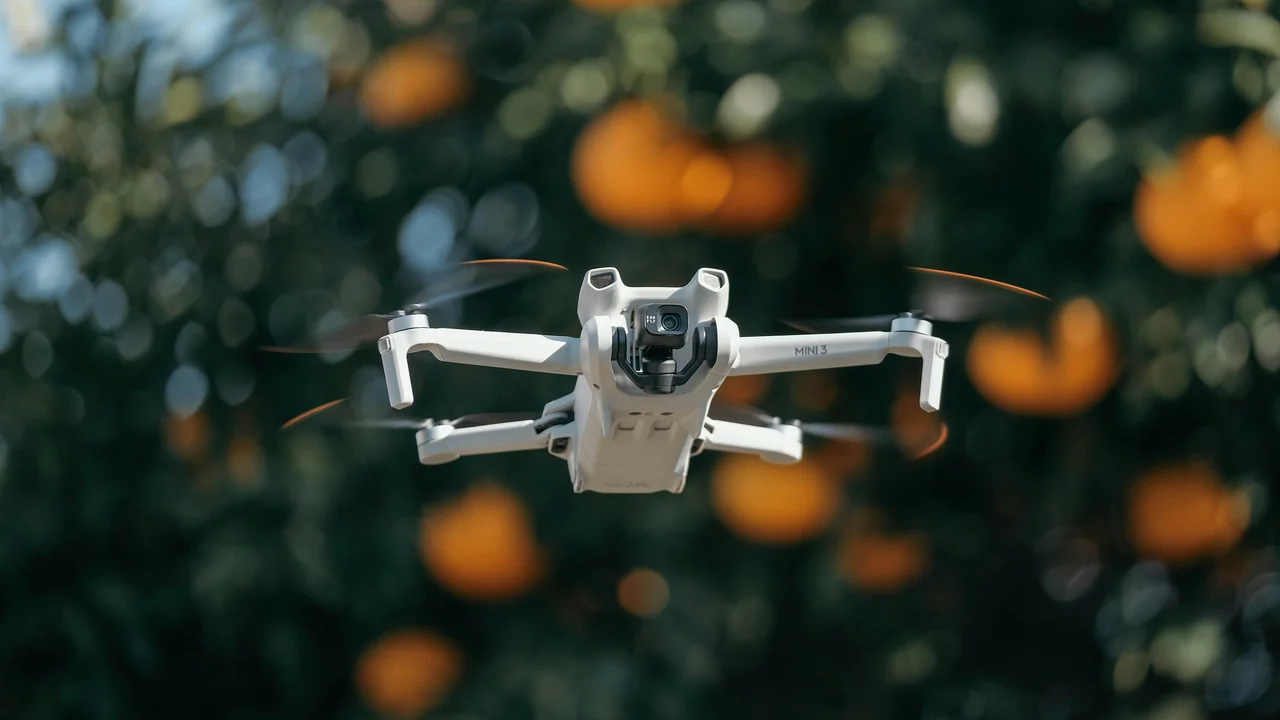
Yes, you can use a DJI Mini 4 Pro for commercial real estate photography, but only if you hold a Part 107 certificate. The Mini 4 Pro weighs under 250g, which exempts it from FAA registration, but the Part 107 requirement for commercial use remains absolute. This drone is an excellent entry point for real estate agents who want to test the market before investing in a larger system. Its 1/1.3-inch sensor and 4K/100fps video capability produce images that look very good on MLS listings and social media.
The trade-offs are real. The Mini 4 Pro lacks obstacle avoidance on its sides and top, which means you must be more cautious when flying near trees or under covered porches. Its smaller sensor struggles more in low-light conditions like twilight shoots. Flight time of 34 minutes is adequate for a single property but may require a second battery for larger homes. For $759, it is a capable tool, but if you are serious about building a real estate photography business, the Air 3 or Mavic 3 Pro will serve you better long-term.
Camera Specifications That Matter for Real Estate Photography
Not all camera specs translate equally to real estate work. Here is what you should prioritize when evaluating a drone for property photography.
Dynamic range is the most important spec. A property interior through a window on a sunny day can have a brightness range of 15 stops or more. A sensor with 12+ stops of dynamic range allows you to capture detail in both the bright exterior and the dark interior in a single frame, reducing HDR blending work in post-production. The Mavic 3 Pro’s 4/3 sensor leads here, but the Air 3 and Mini 4 Pro still perform well with AEB (auto exposure bracketing) modes.
Resolution matters for print and cropping. 20 megapixels is the minimum for professional work. 48-megapixel modes exist on some drones, but they often use pixel-binning that reduces image quality. Stick with the native 20MP output from the main sensor for the best results.
HDR video is increasingly important for video tours. Look for drones that support 10-bit D-Log M or HLG color profiles, which give you more flexibility in color grading to match the property’s true colors. The DJI Air 3 and Mavic 3 Pro both offer 10-bit video, while the Mini 4 Pro is limited to 8-bit.
Flight Performance for Covering Large Properties
When you are shooting a multi-acre estate or a commercial property complex, flight time and speed matter. A drone that needs to land and swap batteries every 25 minutes will significantly slow down your workflow. The Mavic 3 Pro and Air 3 both offer over 40 minutes of real-world flight time, which is enough to shoot a complete exterior tour of a large property on one battery. The Mini 4 Pro’s 34 minutes is workable but tight for larger assignments.
Wind resistance is another factor. Properties near water or in open fields often have gusty conditions. The Mavic 3 Pro handles winds up to 26 mph (12 m/s) with ease, while the Mini 4 Pro can struggle above 20 mph (9 m/s), which may result in shaky footage. If you plan to shoot in coastal areas or during windy seasons, prioritize a heavier drone.
Obstacle Avoidance for Suburban Environments
Real estate photography often takes you into residential neighborhoods with narrow streets, low-hanging tree branches, power lines, and mailbox clusters. Obstacle avoidance is not a luxury here—it is a safety necessity. The Mavic 3 Pro’s omnidirectional system gives you the most protection, detecting obstacles in all directions and automatically braking or rerouting. The Air 3’s forward and backward system is good but requires you to manage lateral movements carefully. The Mini 4 Pro only has downward and forward obstacle sensors, so you must be vigilant about side and top collisions.
Always remember that obstacle avoidance is a backup system, not a substitute for situational awareness. Even the best sensors can miss thin power lines or dark tree branches. Fly slowly and deliberately when approaching a property.
Geofencing and LAANC for Controlled Airspace
Many desirable real estate properties sit near airports or helipads, placing them in controlled airspace. The FAA requires you to obtain an airspace authorization before flying in controlled airspace, which you can get through the LAANC (Low Altitude Authorization and Notification Capability) system. Most DJI drones have built-in geofencing that prevents you from taking off in restricted zones, but you can unlock these zones after receiving LAANC approval.
To use LAANC, you need a Part 107 certificate and a LAANC-enabled app like Air Control, Kittyhawk, or the FAA’s own B4UFLY app. The process takes only a few minutes for most requests, with automatic approvals common for flights under 100 feet. For properties near major airports (Class B airspace), you may need to request a manual FAA authorization, which can take several days. Plan your shoots accordingly.
Best Shooting Modes for Real Estate Drone Photography
To capture compelling property imagery, you need to master these three shooting modes on your drone.
Panorama mode creates wide-angle views that show a property in its full context. Use the 180-degree or 360-degree panorama option to capture the entire lot, surrounding neighborhood, and nearby amenities. The drone automatically stitches the images in-camera, saving you post-processing time.
Orbit mode circles the drone around a focal point—typically the front of the house or a key architectural feature. This creates dynamic video shots that give viewers a 360-degree understanding of the property’s exterior. Set the orbit radius to 30-50 feet for houses to avoid clipping trees or rooflines.
Hyperlapse mode is excellent for showing the property’s surroundings, like traffic patterns, sunset lighting, or neighborhood activity. A 10-second hyperlapse over a 5-minute period can compress a beautiful golden-hour transition into a shareable clip for social media.
Insurance for Commercial Drone Operations
Liability insurance is not legally required by the FAA, but it is practically essential for any real estate drone business. A single accident involving property damage or personal injury could cost tens of thousands of dollars. Most commercial drone insurance policies offer $1 million in liability coverage for around $500-$1,000 per year, depending on your flight hours and drone value.
Some real estate agencies may require you to show proof of insurance before hiring you. Additionally, if you crash your drone, hull insurance covers repair or replacement costs. Given that a Mavic 3 Pro costs over $2,000, hull insurance is a wise investment. Companies like Skywatch, Verifly, and Global Aerospace offer policies tailored to drone photographers.
Pricing: What to Charge Clients for Aerial Real Estate Photography
Your pricing should reflect your equipment costs, Part 107 certification, insurance, travel time, and post-processing work. Based on current market rates in 2026, here is a typical pricing structure for aerial real estate photography services.
| Service | Price Range | Includes |
|---|---|---|
| Basic aerial photos (5-8 images) | $150 – $250 | Exterior shots only, basic color correction |
| Standard package (10-15 images + 1-minute video) | $250 – $400 | Exterior + interior integration, HDR processing |
| Premium package (20+ images + 2-minute cinematic video) | $400 – $600 | Full property tour, hyperlapse, drone + ground footage |
Many real estate photographers bundle aerial services with traditional ground photography to offer a complete package. For agents, a $300 investment in aerial photos can significantly increase listing views and time-on-market metrics. If you are an agent building a referral network with other agents, consider offering a discounted first shoot to demonstrate the value.
Summary: Choosing Your Best Drone for Real Estate Photography
Selecting the best drones for real estate photography in 2026 comes down to your budget, your commitment to image quality, and your tolerance for weight and complexity. For professionals who demand the absolute best image quality and have the budget, the DJI Mavic 3 Pro is the clear winner. Its 4/3 sensor, omnidirectional obstacle avoidance, and 43-minute flight time make it a workhorse for high-end property shoots. For the majority of real estate photographers who want excellent results without the flagship price, the DJI Air 3 offers the best value with its dual-camera system and longest flight time. The DJI Mini 4 Pro is a capable entry-level option, but only if you already hold a Part 107 certificate and are comfortable with its limitations.
Regardless of which drone you choose, remember that your Part 107 certification is the foundation of your commercial operation. Invest the time to study for the exam, understand airspace rules, and carry proper insurance. The aerial photography market for real estate continues to grow, and with the right equipment and legal compliance, you can build a profitable service that sets your listings apart from the competition.
Frequently Asked Questions
Do I need a Part 107 license for real estate drone photography?
Yes, absolutely. Any drone flight that is connected to a business purpose—including taking photos for a real estate listing—requires a Remote Pilot Certificate under FAA Part 107. This rule applies even if you are the listing agent flying your own drone or if you are using a sub-250g drone like the DJI Mini 4 Pro. Flying without a Part 107 certificate for commercial purposes is a violation of federal regulations and can result in fines of up to $1,100 per flight.
Can I use a DJI Mini 4 Pro for commercial real estate photos?
Yes, you can use a DJI Mini 4 Pro for commercial real estate photography, but only if you hold a valid Part 107 Remote Pilot Certificate. The Mini 4 Pro weighs under 250 grams, which exempts it from FAA registration, but the Part 107 requirement for commercial use is not weight-dependent. The Mini 4 Pro produces good-quality images for MLS listings and social media, but its smaller sensor and lack of full obstacle avoidance mean it is best suited for simpler properties and well-lit conditions.
What is the best drone for real estate photos?
The best drone for real estate photos in 2026 is the DJI Mavic 3 Pro, thanks to its large 4/3-inch Hasselblad sensor that delivers exceptional dynamic range and image quality. For photographers on a tighter budget, the DJI Air 3 offers excellent value with its dual-camera system and 46-minute flight time. The DJI Mini 4 Pro is a capable entry-level option for those who prioritize portability and have a Part 107 license.
Do I need to register my drone for real estate work?
Yes, if your drone weighs more than 0.55 pounds (250 grams), you must register it with the FAA through the DroneZone website. The registration fee is $5 and is valid for three years. Drones under 250 grams, like the DJI Mini 4 Pro, are exempt from registration, but you still need a Part 107 certificate for commercial use. You must also display your registration number on the exterior of the drone.
How much do real estate drone photographers charge?
Real estate drone photographers typically charge between $150 and $400 per property for a standard package that includes 10-15 aerial photos and a short video. Premium packages with cinematic video, hyperlapse, and full property tours can range from $400 to $600. Pricing depends on property size, location, travel distance, and the complexity of post-processing required. Many photographers bundle aerial services with traditional ground photography for a complete package.
Can I fly near houses in controlled airspace for real estate?
Yes, you can fly near houses in controlled airspace, but you must first obtain an airspace authorization through the FAA’s LAANC system. LAANC provides near-instant approvals for most requests, especially for flights under 100 feet. You need a Part 107 certificate and a LAANC-enabled app to submit your request. For properties near major airports in Class B airspace, you may need to request a manual authorization, which can take several business days to process.
Last updated: June 25, 2026
- Federal Aviation Administration (FAA) – Part 107 Small Unmanned Aircraft Systems
- FAA DroneZone – Registration and LAANC Authorization
Drone Allowed
DroneAllowed editor covering drone regulations, aviation law, and aerial photography across USA, UK, Canada & Australia.